

PROPERTYINFO.SG
Propertyinfo.sg is the official website for the latest property launches and showflats in Singapore! Contact us for the floorplans and layout of any new launch projects in Singapore.
Buy, Sell, Invest, In Singapore.
Singapore is well regarded for being an excellent location for foreigners, investors, and entrepreneurs wishing to grow into Asia. A few factors that make it appealing are its growth into a financial center that promotes trade, strong infrastructure, and a solid, forward-thinking legal and regulatory environment.
Why Singapore?
It is a major financial center in Asia.
Singapore benefits from government policies that present the nation as open to commerce, draw in foreign direct investment, and welcome the establishment of international businesses. Singapore is the third-richest country on earth and the fourth-largest financial hub in the world. The largest foreign exchange (FX) center in the Asia-Pacific is located there, and it ranks third globally behind New York and London. With these plaudits from abroad, it should come as no surprise that the nation is praised as the de facto financial hub of Southeast Asia.
why is it ideal for enterprises and corporations?
The nation’s Economic Development Board will benefit from incentives and programs. EDB commits major resources to helping foreign companies and people establish themselves here and offers top-notch support along the way. If you’re an international investor, its effective regulatory framework allows it hassle-free to establish a company or firm.
Looking to invest in singapore?
Speak with our trusted agent!
Economic Entry Point To The Worldwide
Numerous opportunities are presented to investors and enterprises headquartered here by its close proximity to neighboring nations and important regional markets. Singapore has a comprehensive 25 free trade agreements in place, many with significant global markets, thanks to its attitude on supporting international trade and business. This gives investors and enterprises headquartered here great access to these significant economies.
Tax Advantages
The progressive income tax rates that apply to residents of Singapore range from 0% to 22%. At the moment, Singapore does not impose estate taxes, capital gains taxes, or inheritance taxes. When buying scripless shares listed on the Singapore Stock Exchange, investors are exempt from paying stamp duties because the Central Depository (CDP) transfers these shares electronically. The progressive income tax rates that apply to residents of Singapore range from 0% to 22%. At the moment, Singapore does not impose estate taxes, capital gains taxes, or inheritance taxes. When buying scripless shares listed on the Singapore Stock Exchange, investors are exempt from paying stamp duties because the Central Depository (CDP) transfers these shares electronically. Singapore-based companies are subject to a flat 17% corporate income tax rate. Singapore-based companies can take advantage of a number of tax breaks and grants
Why ECs Are The Best Investment
Given the peak in housing prices in 2022, demand for executive condominiums (ECs) is higher than ever. Although there are approximately a minimum of 4 ECs being launched in 2022, are they the best choice for asset progression? In 2025, Executive Condominiums (ECs) in Singapore continue to be a compelling investment option due to several key factors.
The Singapore property market is projected to experience a modest price increase of 1-2% in 2025, aligning with inflation expectations. This stable growth, coupled with a favorable interest rate environment, enhances the affordability and attractiveness of ECs as an investment. Furthermore, the government’s ongoing cooling measures and policies aimed at maintaining housing affordability contribute to a balanced market, reducing the risk of speculative bubbles. These measures ensure that ECs remain a viable and secure investment choice for both first-time buyers and seasoned investors.
What is an EC?
In Singapore, one of the most prevalent housing kinds is the executive condo (EC). With comparable amenities and features to private condominiums, ECs in Singapore are more “atas” than HDB flats and more reasonably priced. Private developers create and market ECs, but the government provides subsidies. As a result, they are less expensive than private condos even though they have condo-like amenities including swimming pools, gyms, clubs, and finer design.
Variety Of Profitable Options To Choose From
HDB resale prices increase by 0.6 % in June 2023 compared to May 2023. Mature Estates and Non-Mature Estates prices increase by 0.7% and 0.6% respectively, as compared to May 2023. In terms of room types, 3 Room prices increase by 0.4%, 4 Room prices increase by 0.8%, 5 Room prices rise at 1.0% while Executive prices decrease by 1.1%. As of 2025, the value of Executive Condominiums (ECs) continues to appreciate as they near privatization, which happens after 11 years. Once privatized, ECs become available to a broader range of buyers, significantly increasing their value. Investors often benefit from this transition, as privatized ECs offer higher resale prices and more demand in the market.
Looking at 2025, the EC market continues to attract both first-time homebuyers and investors due to its combination of affordability and high potential for capital appreciation. The demand for ECs in prime locations, particularly those with strong infrastructure links and community amenities, remains strong. Furthermore, the government’s policies ensuring housing affordability and moderating market speculation continue to support long-term value retention in ECs. For those seeking higher returns, leasing out privatized ECs post-MOP can also yield significant rental income, particularly in areas with high demand from both local residents and expats.
Complete Guide to Buying Property in Singapore
Buying your first property in Singapore can be exciting but overwhelming. Start by understanding your budget, including cash savings and CPF Ordinary Account (OA) funds, and factor in costs like stamp duties, legal fees, and renovation. Decide on the type of property — HDB flats, Executive Condominiums (ECs), or private condominiums — each with its own eligibility criteria, financing rules, and lifestyle considerations. Getting a loan pre-approval from HDB or a bank helps you know your budget, while understanding how much CPF you can use for down payments and monthly installments ensures you stay within your financial limits.
Next, research the location carefully. Proximity to MRT stations, schools, parks, and shopping malls can affect both your daily convenience and long-term property value. Consider future developments and neighborhood trends, as these influence resale potential and rental demand. Engaging a qualified property agent can save time, help negotiate offers, and provide insights on pricing and market trends. Once you’ve selected a property, secure it by submitting an Option to Purchase (OTP) or Letter of Intent, paying the necessary down payment, and completing legal processes with a conveyancing lawyer.
Finally, plan long-term. Stick to your budget, check CPF usage limits, and keep key documents ready. Think beyond the purchase — consider resale value, rental potential, and lifestyle needs. By following these steps, first-time buyers can confidently navigate the Singapore property market and make informed decisions that align with their finances and future goals.
CPF Grants Benefits
You may qualify for CPF Housing Grants, which can help with some of the cost, if you purchase an executive condo during the HDB EC launch. For ECs, the two different kinds of grants available are family grant and half – housing grant
the good news is that you can still receive “half” of the cpf grant in the form of the half-housing grant if you’re a first-time buyer of an executive condo with a co-applicant who has previously received a housing subsidy. the grant amount is as follows:
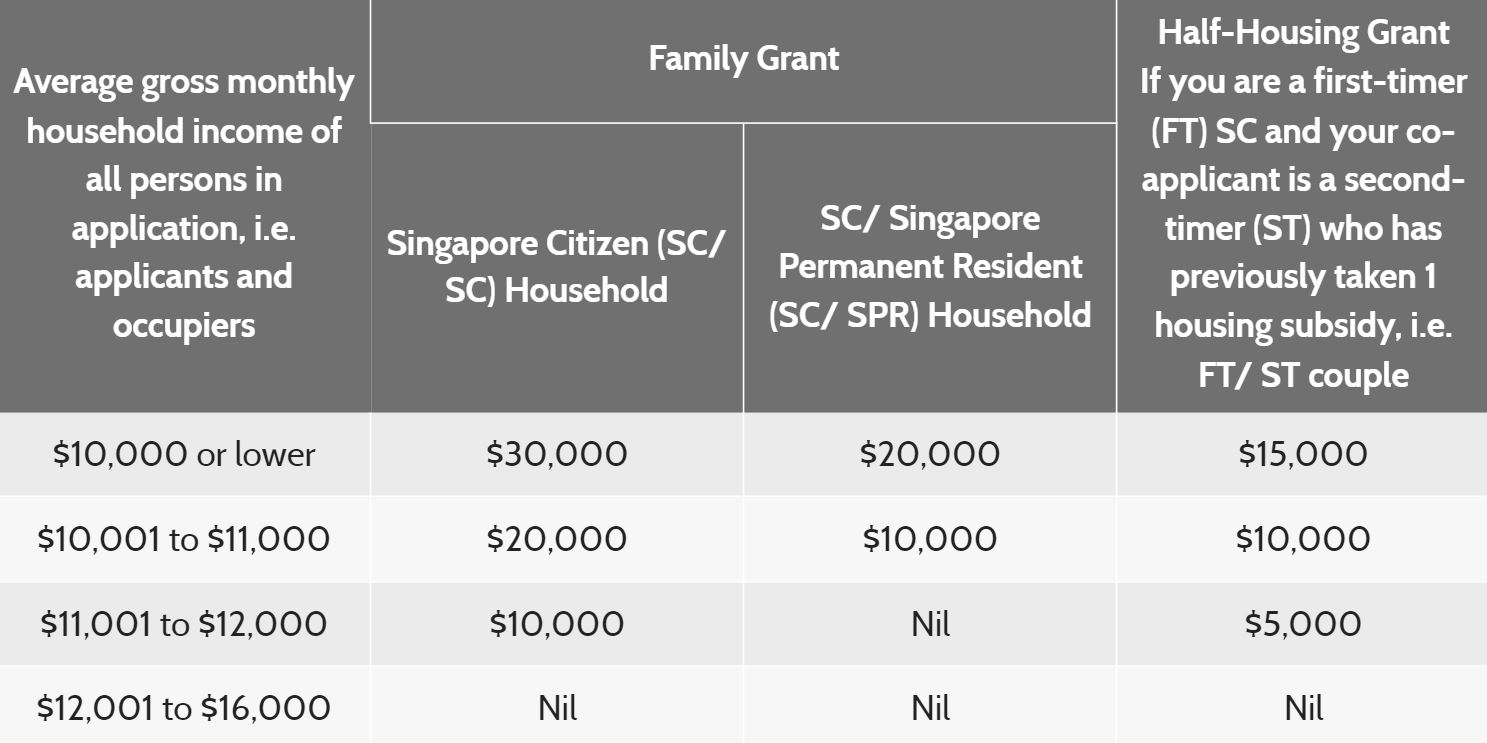
Source : Hdb.gov.sg
Singapore Property Market Updates
📊 Price Trends & Market Momentum (2025 → 2026)
Private Residential Property
• Singapore’s private home prices extended their rally into a ninth consecutive year of growth in 2025, although price increases slowed compared to earlier years. (Source: Bloomberg)
• URA flash estimates show private residential prices rose about 3.4% in 2025, marking the slowest annual growth since 2020. (Source: The Straits Times / Urban Redevelopment Authority)
• Price growth has moderated largely due to cooling measures, higher interest rates, and increased housing supply entering the market. (Source: The Business Times)
• Despite slower growth, demand remains supported by HDB upgraders, investors, and foreign buyers in selected segments. (Source: EdgeProp Singapore)
Price Forecast for 2026
Property analysts expect the market to remain stable with moderate growth.
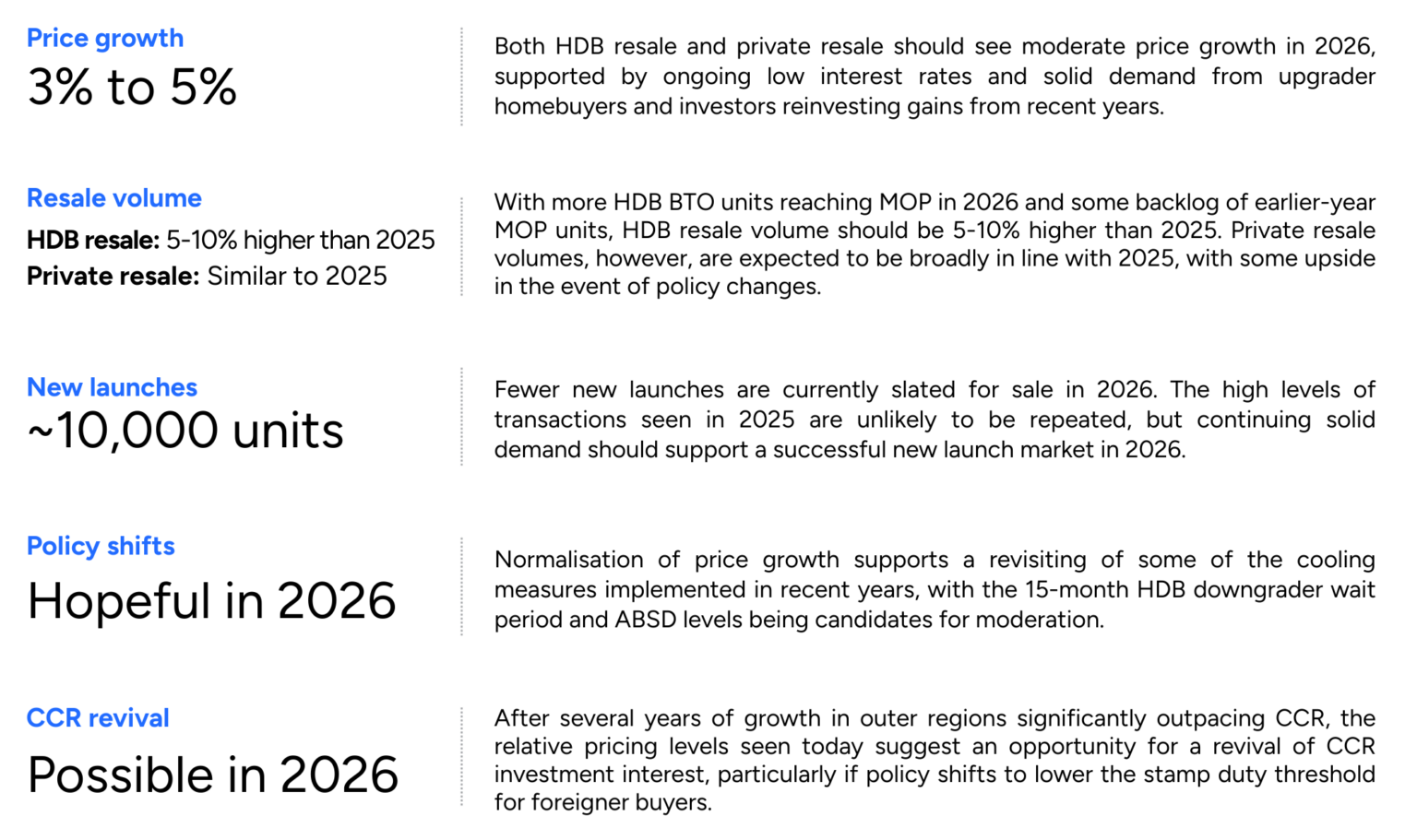
• Private home prices are projected to increase around 2.5% – 4.5% in 2026, depending on economic conditions and new launch supply. (Source: Channel NewsAsia)
• Some market reports expect around 3% price growth in 2026, supported by gradually easing mortgage rates and steady housing demand. (Source: Singapore Business Review)
• Mass-market condominiums are expected to continue seeing strong demand from HDB upgraders entering the private property market. (Source: EdgeProp Singapore)
HDB Resale Market
The public housing resale market is also showing signs of stabilisation.
• HDB resale prices rose about 2.9% in 2025, slower than the strong growth seen during the pandemic years. (Source: Channel NewsAsia)
• More flats reaching their Minimum Occupation Period (MOP) in 2026 are expected to increase resale supply. (Source: EdgeProp Singapore)
• Increased Build-To-Order (BTO) launches are also helping balance demand and supply in the public housing market. (Source: Housing & Development Board)
Core Central Region (CCR) Momentum
The luxury property segment in Singapore’s prime districts is starting to regain traction.
• The price gap between CCR properties and suburban condos has narrowed, making prime homes relatively more attractive to buyers. (Source: Capstack)
• Some buyers who previously focused on suburban launches are now reconsidering city-centre properties for long-term value. (Source: Bloomberg)
• Analysts believe the Core Central Region (CCR) could see renewed interest from both local upgraders and international investors. (Source: EdgeProp Singapore)
Email us for the full articles!
🌍 Global War Impact on Singapore Property Market (2026 Update)
📊 Immediate Market Effects
• Oil prices surged as global energy supply routes were disrupted, particularly through the Strait of Hormuz, which handles about 20% of global oil shipments. (Source: Reuters / global energy reports)
• Rising fuel costs are increasing global inflation, which could slow economic growth and affect housing affordability worldwide. (Source: The Guardian)
• Shipping disruptions and higher fuel costs are also affecting Asian supply chains, including Singapore’s port activity. (Source: Reuters)
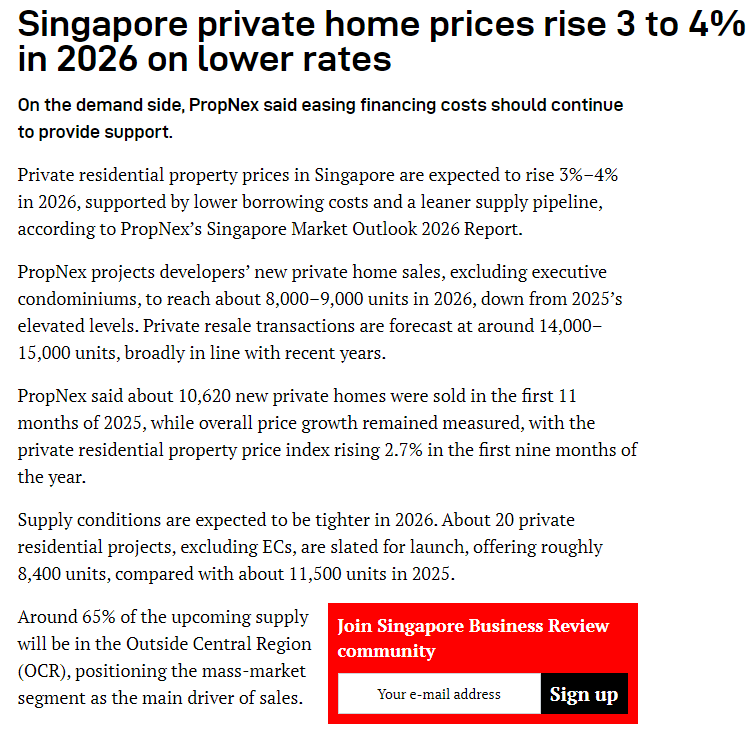
Despite the global uncertainty, Singapore property has historically remained relatively stable during geopolitical crises.
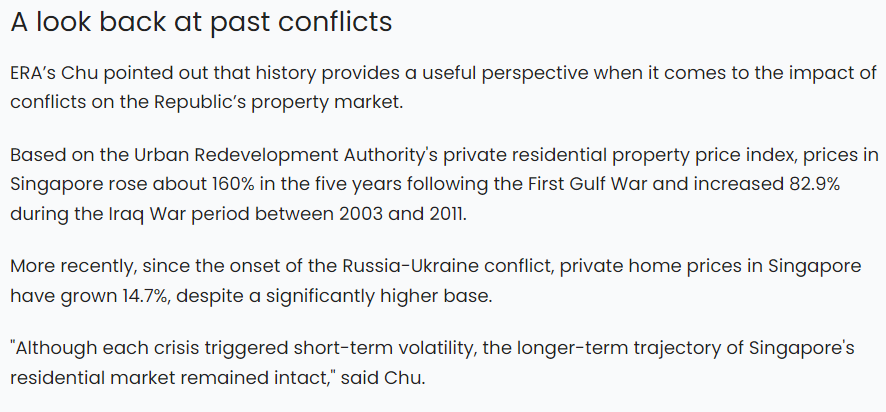
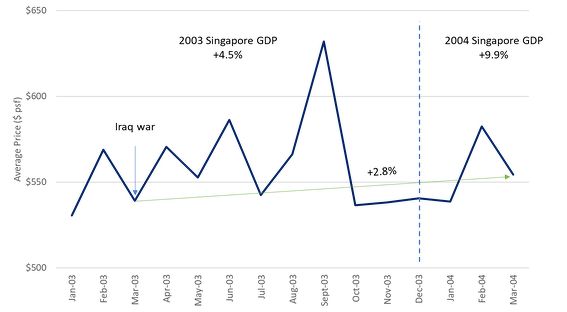
• Singapore property prices actually rose about 2.8% in the year after the Iraq War began, showing resilience during global conflicts. (Source: EdgeProp / Huttons analysis)
• Since the start of the Russia-Ukraine conflict, private home prices in Singapore have increased about 14.7%, highlighting continued demand despite geopolitical tensions. (Source: property market analysis reports)
• Analysts say Singapore is often viewed as a “safe haven” real estate market, attracting investors during periods of global instability.
Even with global conflict risks, analysts still expect moderate price growth.
Private residential property
• Prices expected to rise about 2% – 4% in 2026 depending on economic conditions.
• Luxury homes may see stronger demand due to safe-haven investment flows.
Mass-market condos
• Demand remains supported by HDB upgraders and local buyers.
• Prices expected to remain stable due to limited unsold inventory.
⚠️ Key Risks if the War Escalates
The main risks for the Singapore property market are indirect economic effects, not the war itself.
Possible impacts include:
• Higher interest rates if global inflation rises
• Slower GDP growth in Singapore
• Reduced investor confidence if global markets fall
• Higher construction costs due to material and energy price increases
However, analysts note that Singapore’s strict housing policies, cooling measures, and strong economy help stabilise property prices even during global crises.
✅ Key takeaway for buyers and investors
• Singapore property is generally less volatile than stock markets during wars.
• Prices may grow more slowly, but a major price crash is unlikely unless there is a severe global recession.
• Safe-haven demand could even support prime property segments.
Email us for the full articles!
📉 Interest Rates & Affordability
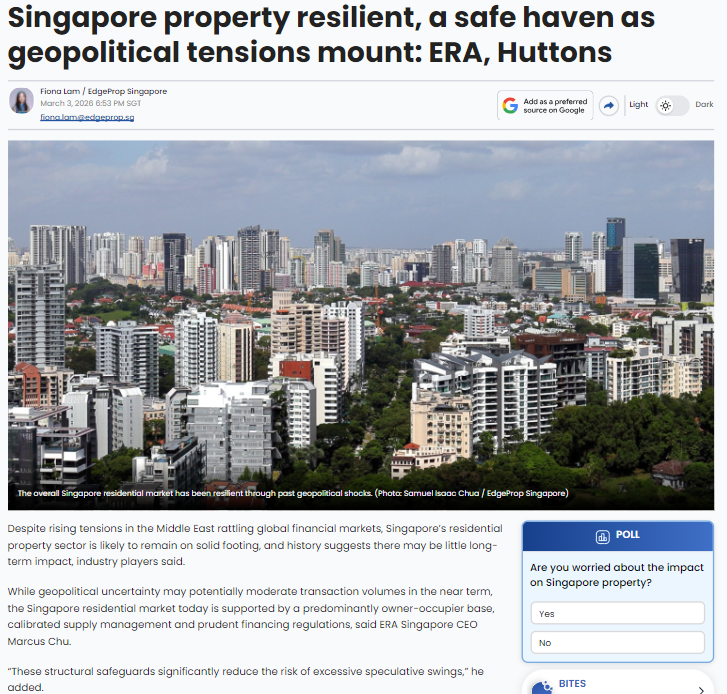
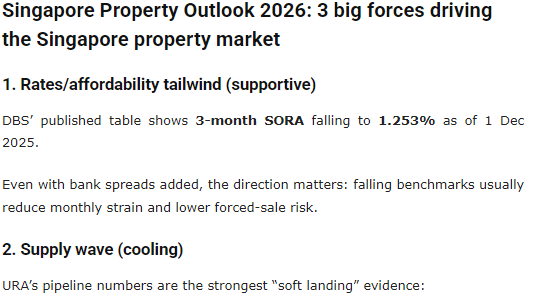
Falling interest rates are a key support factor in 2026 property demand:
– Mortgage rates have eased meaningfully compared with 2024–2025, improving affordability and encouraging owner‑occupier and upgrader purchases.
Lower interest rates also mean rental yields may look more attractive, particularly with mortgage cost savings factored in (especially for investment plays).
Email us for the full articles!
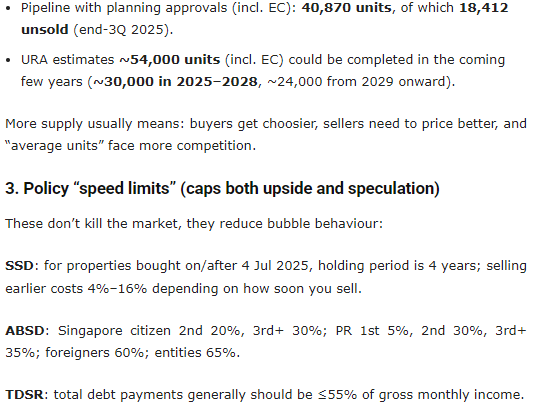
🏠 Residential Rental Market (HDB & Private Condos)
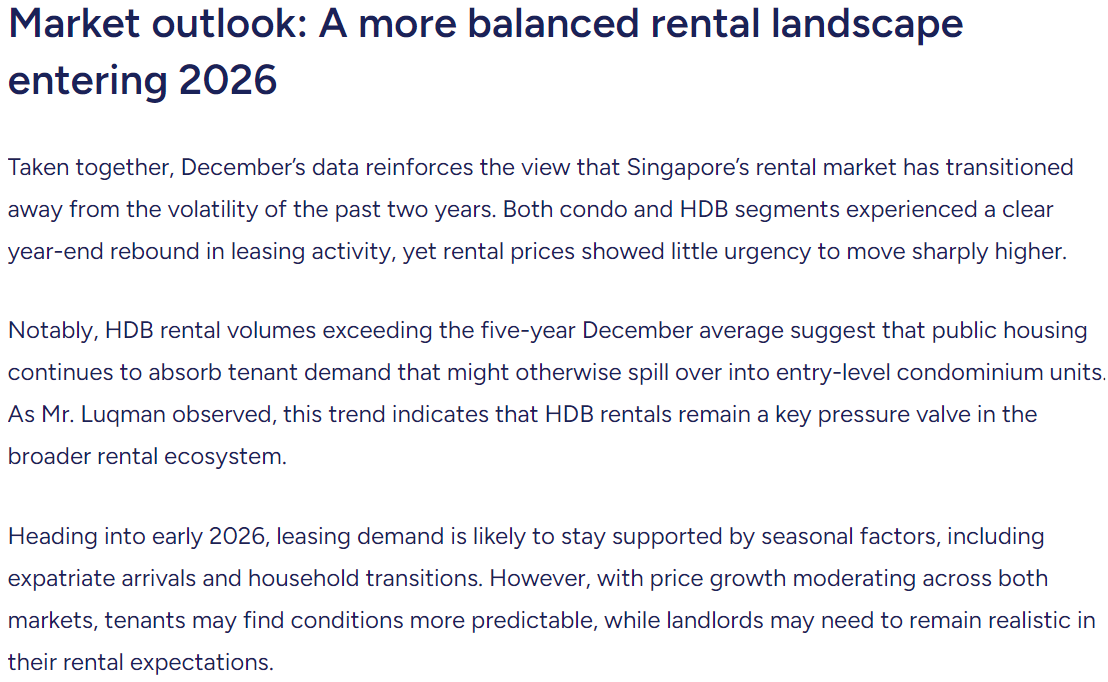
– Residential rents have broadly stabilised heading into 2026 after significant volatility in the past few years. Rental rates for both condos and HDB flats showed modest increases late in 2025, indicating that demand remains intact but growth is no longer as steep as during the post‑pandemic rebound. (Source: SRX / Condo & HDB Rental Data)
– Rental volumes rebounded in December 2025 with a notable rise in the number of units leased compared with November 2025. This pickup is often seen at year‑end, as expatriates and locals alike secure housing before the new year term and work commitments, helping strengthen leasing activity into 2026. (Source: 99.co – Rental Volume Report)
– Rents are growing at a more moderate pace: year‑on‑year increases were modest overall, with private and public rental prices inching up by low single digits. This reflects a shifting rental cycle where rents remain firm but balanced by increased supply. (Source: SRX / Condo & HDB Rental Data)
Email us for the full articles!
👥 Policy & Regulatory Support
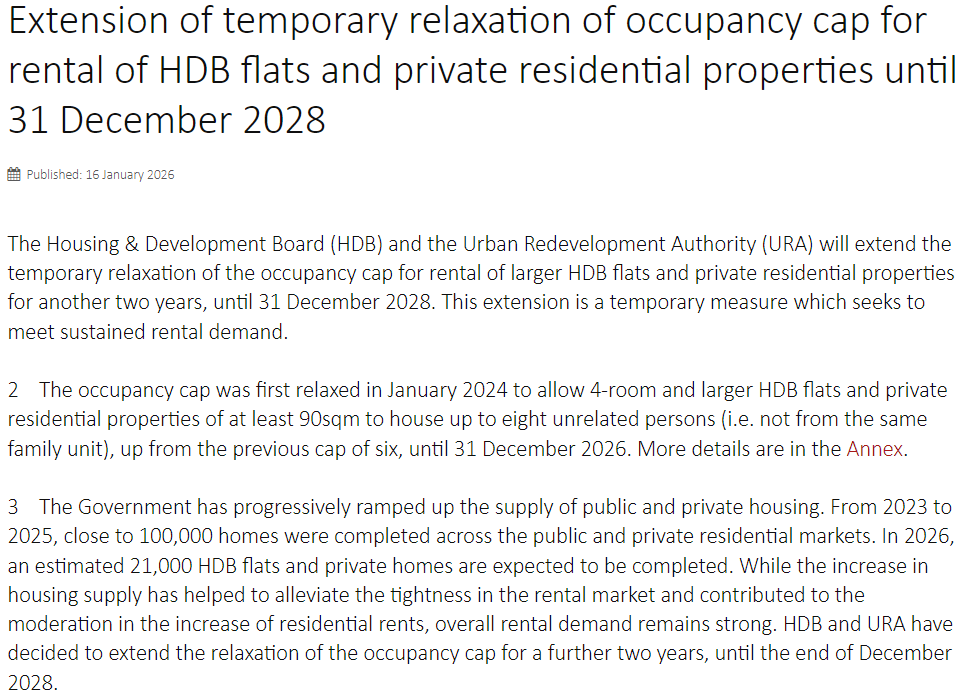
– The temporary relaxed rental occupancy cap that allows up to eight unrelated tenants in larger HDB flats and private residential properties has been extended to 31 December 2028. This policy expands housing flexibility for larger households, students, and workers needing shared accommodation, which in turn can ease rental pressure. (Source: URA Media Release)
– Originally introduced in 2024 and slated to end in 2026, the extended cap aims to support rental demand amid a gradually rising supply of new homes. Authorities have noted that continued monitoring will determine whether further extensions are needed beyond 2028. (Source: Straits Times – Rental Cap Extension)
– The relaxed occupancy policy has been highlighted by analysts as a stabilising factor in the market, particularly as private rents experienced several consecutive quarters of increases before moderating. (Source: Yahoo News Singapore – Rental Cap Details)
Email us for the full articles!
📈 Outlook – What’s Ahead in 2026
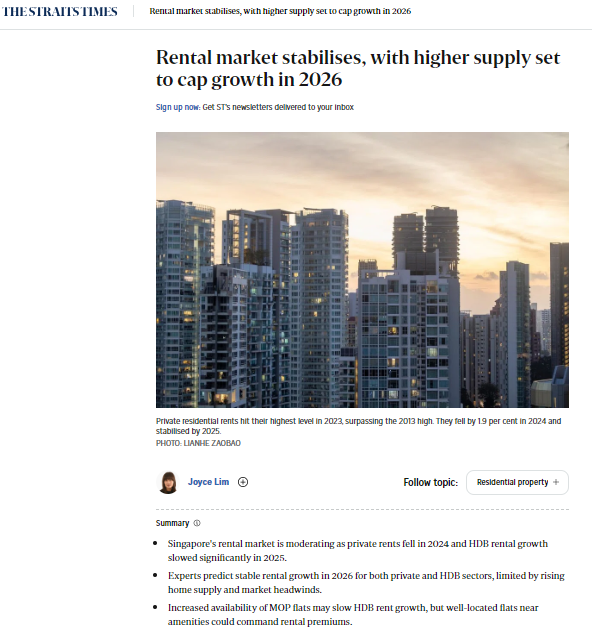
– Overall rental growth in 2026 is expected to be steady but measured, with rents stabilising rather than escalating. Analysts point out that rising supply — both new builds and MOP flats — will temper rental increases compared with the strong upward trend seen in earlier years. (Source: Straits Times – Rental Market Outlook)
– Well‑located units — such as those near MRT stations, schools, and employment hubs — will continue to command rental premiums due to ongoing tenant preference for convenience and lifestyle amenities. (Source: Straits Times – Rental Market Outlook)
– Policy measures like the extended occupancy cap help preserve a more balanced rental environment by providing flexibility without overstimulating rent hikes. (Source: URA Media Release)
Email us for the full articles!
“Buying an EC is like buying a Lexus for the price of a Toyota Corolla”
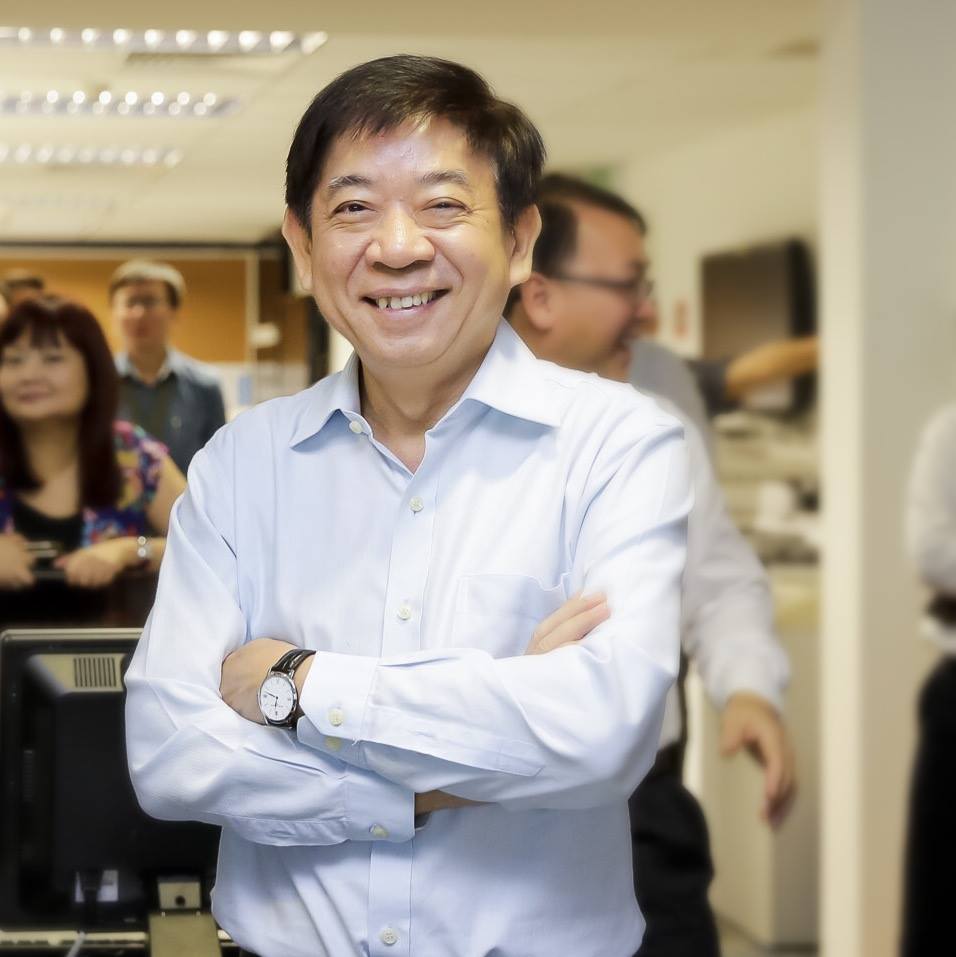
KHAW BOON WAN
Minister for Transport ( 2015 – 2020 )

